
Show Me Your Org Chart, I'll Predict Your Robot's Failure Mode
Conway's Law isn't a metaphor. It's a structural prediction tool. The AV industry already paid the tuition. Here is the five-question diagnostic I use before signing any offer letter or term sheet.

Part of The AV Playbook, a Signal Path series.
At Rivian, every architecture decision had two reviewers. The ML feature lead approved the model. The hardware lead approved the on device budget, the thermal envelope, and the wiring harness the model would have to live inside. Neither could overrule the other. That second reviewer is the difference between a perception stack that demos and a perception stack that ships.
Most well-funded humanoid startups today have only the first reviewer.
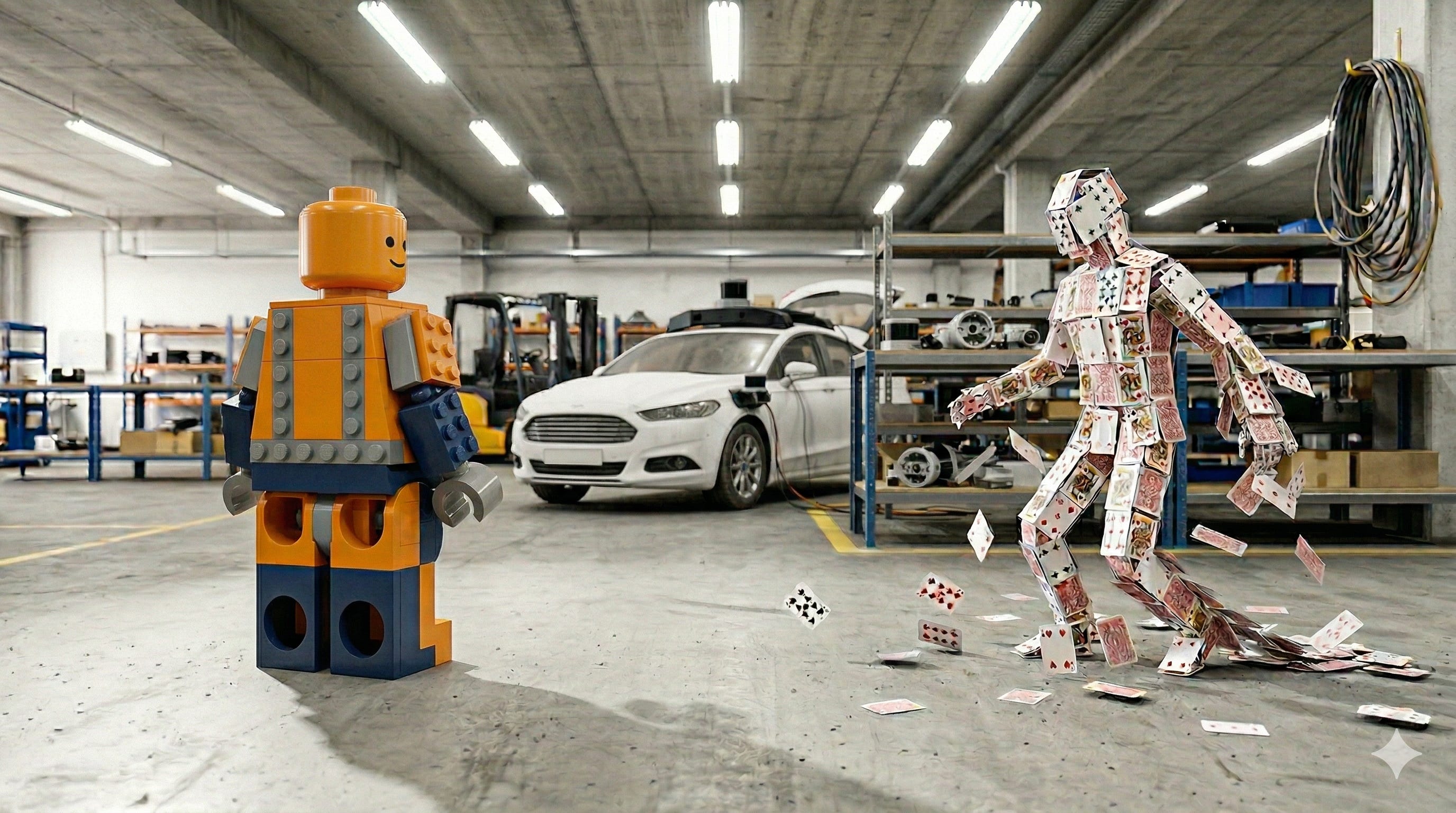
I call this the Org-Architecture Mirror. Conway’s Law, applied to Physical AI. A shipped robot is a faithful reflection of the org that built it. Show me a humanoid company’s leadership page and I will tell you which failure mode it ships with, two years before the first deployment lands.
Melvin Conway proved this in 1968. In a paper that Harvard Business Review rejected for “lack of evidence” and Datamation eventually ran, he observed that any system an organization produces is isomorphic to the communication structure of that organization. Forty-eight years later, Colfer and Baldwin tested it empirically across 102 studies. The mirroring hypothesis held in 69% of cases. The org chart constrained which architectures were even possible.
I have spent the last year watching humanoid companies repeat mistakes the AV industry already paid for. With robotics startups raising nearly $14 billion in 2025, the cost is not just engineering time. It is careers, capital, and the safety record of an industry that has not yet earned the public’s trust.
This piece walks the Mirror through four lenses (the mirror itself, what AV already taught us, the safety blind spot) and lands on the Org-Architecture Diagnostic: five questions I use to evaluate any humanoid company before I take a job, write a check, or join a board. In shorthand: who can veto an architecture decision, where manufacturing reports, whether a Chief Systems Engineer exists with real authority, whether safety has a named owner, and whether the stack is built for modules or for integration. The build below explains why each question is load-bearing.
I. The Org-Architecture Mirror in humanoid robotics
The Org-Architecture Mirror is not a metaphor. It is a structural prediction tool. The leadership structure your company has today shows up in the technical architecture your product ships with two years from now. Directly, not eventually.
Look at the leadership pages of the top humanoid companies by funding. A pattern emerges. The CEO comes from a software, marketplace, or pure-research background. The VP of AI comes from an ML perception stack. The VP of Hardware reports laterally without veto authority. There is no Chief Systems Engineer, no Chief Safety Architect, no equivalent to the role in aerospace whose entire job is owning the integration layer between perception, planning, and the physics of the actuator.
The org is built around the VLA playbook: train a foundation model on internet-scale data, fine-tune on robot trajectories, ship end-to-end. The architecture assumes software eats the problem. The org chart mirrors that assumption. This is structural, not personal. When the CEO is a software person, the VP of AI is a perception person, and the VP of Hardware does not have a veto, the ML team wins every resource conflict by default.
Figure AI’s Helix reorganization is the move playing out in real time. In May 2025, CEO Brett Adcock announced the “largest re-org in Figure’s history”: three previously separate teams (hardware engineering, software systems, embedded systems) consolidated into a single AI group named Helix. “Figure is an AI company at its core,” Adcock said. That sentence is the architecture spec. The org chart now says AI is the center of gravity and everything else orbits it. Whether that produces breakthrough or breakdown, the architecture will be downstream of the structure.
The counterpoints are not the companies with the best demos. They are the ones with the most boring-looking leadership pages.
1X Technologies was founded in 2014 by Norwegian roboticist Bernt Børnich, who still runs it as a hardware-first founder. The company designed and manufactured its own actuators years before the VLA wave. When Eric Jang served as VP of AI, he came in from six years inside Google Robotics. His successor Mohi Khansari came from Everyday Robots and Cruise. Both are deployment shops. The 1X AI org has, twice in succession, hired leaders whose careers were built around getting things to work in the real world. The result is NEO, launched in October 2025 with the first home robot pre-orders in the consumer market, designed against explicit constraints from 1X’s own manufacturing process.
Tesla Optimus is embedded in a company that has shipped millions of cars. Tesla designs its own actuators, runs Optimus on its own FSD compute chip, and is converting Fremont production lines into an Optimus manufacturing hub. Every software decision is tested against manufacturing reality before it ships. The org chart creates a desirable failure mode: you cannot design a robot that requires unrealistic tolerance stacks because your manufacturing team will refuse it. The Optimus Gen 3 hand, with 50 actuators per arm moved into the forearm, is designed for factory assembly, not for demos.
Agility Robotics is the cleanest example of the mirror working in a company’s favor. Co-founder Jonathan Hurst is an Oregon State robotics professor who runs technical direction as Chief Robot Officer. The CEO since March 2024 is Peggy Johnson, former Magic Leap CEO and a 24-year Microsoft executive. She is an enterprise operations leader, not an ML researcher. The CTO since May 2024 is Pras Velagapudi, a CMU robotics PhD who previously deployed fleets of hundreds of warehouse robots as Chief Architect of Mobile Robotics at Berkshire Grey. When Melonee Wise stepped down in August 2025 to lead KUKA’s new software and AI organization, Velagapudi already owned the technology strategy. Agility replaces deployment-experienced leaders with deployment-experienced leaders. The result is an org whose Digit deployment at GXO fails in the expected domain (mechanical wear, firmware tuning) rather than in “we designed assuming unlimited compute and now we cannot manufacture it.”
The pattern holds across every company I have examined. Where the org chart gives hardware and systems engineering symmetric authority with ML, the architecture reflects the balance. Where it does not, the robot demos beautifully and deploys poorly. The mirror is doing exactly what Conway said it would.
II. What the AV industry already taught us
The humanoid industry is repeating the AV pattern from 2012-2014, and the lessons are sitting in public documents.
When AV started, the industry believed perception and planning were the hard problems. Better sensors, more data, the rest would follow. The org charts reflected the belief. What the industry discovered is that the hard problems are the ones that do not show up in papers: fault tolerance, edge case recovery, graceful degradation, deterministic fallback. Those are systems engineering problems, not ML problems.
Waymo did not start with systems engineering at C-level. In November 2018 it created an entirely new role, Chief Safety Officer, hiring Deborah Hersman, former chairwoman of the National Transportation Safety Board, reporting directly to the CEO. The org chart changed because the architecture had to.
Cruise tells the structural version of the same story. The Quinn Emanuel investigation commissioned by GM traced the 2023 incident response to “culture issues, ineptitude and poor leadership,” not to any single engineering decision. The org chart had been engineering-speed-first with safety as a supporting function, and when the gap was exposed the company did not survive in its prior form. (I covered the operational arc in The AV Scoreboard.)
The AV industry also produced a structural shift with direct implications for humanoid orgs. The old stack was modular. Tesla’s FSD v12 collapsed it into a single end-to-end neural network, replacing 300,000 lines of C++. Figure’s Helix does the same move for humanoids, as does NVIDIA’s GR00T N1. Modular orgs will fight to preserve module boundaries when architectural pressure pushes the other way. People defend the structures they are embedded in. Conway again.
Boston Dynamics is the case study for the product delivery lesson. Robert Playter stepped down in February 2026 after 30 years; the interim CEO is CFO Amanda McMaster. A successor arriving via the CFO chair, not the engineering chair, is the company telling the market what muscle it now needs to grow. The org chart that builds an extraordinary research robot and the org chart that commercializes one at scale are structurally different things, and one company rarely contains both.
A decade of AV teaches one rule. When a system is safety-critical and requires manufacturing scale, the org chart has to reflect that from day one. By the time you discover you need systems engineering authority at C-level, the architectural decisions are already embedded.
III. The safety blind spot
Every commercial aerospace company has a Chief Systems Engineer at C-level. NASA does. The military does. SpaceX distributes the function through “Responsible Engineers”. The role exists because in safety-critical systems, integration is non-negotiable.
The deeper pattern is singular accountability for the integration layer. Not a benevolent dictator. Not a veteran whose gut overrides the data. A named role whose job is owning the boundaries between sub-systems and making the call when two teams’ local optima conflict. A perception team’s accuracy metric does not capture the actuator wear its model induces. A planner’s latency metric does not capture the thermal load it imposes on compute. In a data-only culture, “who decides when two teams’ metrics conflict” defaults to whichever VP is louder. That is politics with a dashboard. Singular accountability is what makes the dashboard load-bearing. When the role exists in title only, without budget or a direct CEO reporting line, the substance is missing.
In automotive, the Chief Systems Engineer owns ISO 26262 and SOTIF (ISO 21448) compliance. These are the reason you can insure a vehicle. Almost no humanoid startup has the role, and the standards landscape is a vacuum: ISO 10218:2025 covers industrial arms, ISO 13482:2014 covers personal care robots and predates the current humanoid wave by a decade. There is no ISO 26262 equivalent for humanoids. End-to-end VLA does not delete the integration layer. It moves it to the boundary between a learned policy and an actuator that still has a torque ceiling.
The core problem, as Federico Vicentini, Boston Dynamics’ Head of Product Safety, has articulated, is that humanoids require active control to remain standing. A humanoid collapses when power is cut. Proving safety is an order of magnitude harder than for stationary robots. ISO 25785-1, a new Type C standard for “industrial mobile robots with actively controlled stability,” is under development with Vicentini chairing the U.S. delegation. It remains a Working Draft. The safety threshold is not kinetic energy parity with a car. It is uncontrolled mass falling on a person in a shared room. Until the standard lands, the companies that voluntarily build to automotive-grade rigor will own it when regulators catch up.
When a humanoid leadership page has no Chief Systems Engineer, no Chief Safety Architect, no VP of Safety with authority symmetric to the VP of AI, the consequence of a perception failure is not a degraded benchmark number. It is a physical safety event. The blueprint for fixing this exists. Humanoid companies do not have to wait for their own Waymo restructuring or Cruise collapse to use it.
IV. The Org-Architecture Diagnostic
Each question below carries two annotations: what an engineer should see in the org chart, and what a founder, investor, or board member should see. Same chart, two angles, one decision.
The diagnostic is not an argument for hardware supremacy. Honda’s Asimo and old Boston Dynamics tried that and never crossed the deployment cliff either. What ships is symmetric veto. Hardware can stop ML, ML can stop hardware, and neither wins alone in the CEO’s office.
1. Who has veto power over architecture decisions?
If ML leadership can override hardware constraints unilaterally, the architecture will be optimized for what the model can do, not for what the actuator can deliver.
For the engineer: your work will be evaluated against benchmarks that do not transfer to the production environment. Two years in, the manipulation skills you trained will not execute on the manufactured hand because the actuator cannot generate the required torque inside the actual power budget.
For the operator or investor: the company is structurally biased toward capability claims that do not survive contact with deployment. Discount the demo accordingly.
2. Where does manufacturing or deployment sit in the reporting structure?
If manufacturing reports two or more levels below the CTO, the company has decided that production is an execution detail, not a constraint on design.
For the engineer: you will spend your time firefighting integration problems that better organizational structure would have prevented at the architecture stage. The work will be valuable but invisible.
For the operator or investor: the gap between unit economics in the deck and unit economics in production will be larger than disclosed, because the people who own production cost are not in the room when architecture is decided.
3. Is there a Chief Systems Engineer or equivalent with authority across both software and hardware?
In aerospace and automotive, this role is non-negotiable for any safety-critical system. Its absence is a structural prediction. Its presence in title only, without budget authority, hire and fire authority, and a direct CEO reporting line, is a different structural prediction with the same outcome.
For the engineer: integration decisions get made by whoever has the most organizational power, which in most well-funded humanoid startups means ML. If you joined to do systems work, you will discover that the systems work has been distributed and orphaned.
For the operator or investor: the company has not internalized the lesson the AV industry already paid for. The next safety incident will not be a recoverable PR event because no single executive owns the response.
4. Is there a dedicated safety architecture function with leadership-level representation?
Safety distributed across teams without a single owner is safety nobody owns. The Quinn Emanuel report on Cruise did not blame engineers. It blamed structure.
For the engineer: when a safety-relevant failure mode appears in your work, there will be no escalation path that does not require fighting for resources from teams whose incentives point elsewhere.
For the operator or investor: the company is one incident away from a regulatory event it is not structured to survive. Humanoid regulators will not be more lenient than the NHTSA enforcement the AV industry already absorbed.
5. Is the stack organized around modular ownership or full-system integration?
Modular orgs with separate perception, planning, and control teams will resist the end-to-end shift that AV already demonstrated is necessary, because the org has optimized for module boundaries.
For the engineer: if you joined a single-module team, your career will be defined by how successfully you can defend that module’s autonomy from architectural pressure that wants to collapse it. That is a political battle, not an engineering one.
For the operator or investor: the company will spend at least one funding cycle on an internal restructuring it could have done at founding. That cycle is your money.
These questions will not appear in a job description or a standard interview loop. They determine whether a company ships or pivots. Use the framework before signing the offer letter or the term sheet.
My read: a Bayesian forecast
The prior. Across fifteen years, the AV cohort produced a handful of commercial survivors out of more than a dozen serious attempts. Survivors gave systems engineering or safety architecture C-level authority before scaling. Casualties did not. The base rate for ML-dominant deep tech crossing a deployment cliff with safety implications sits well below 50%.
The updating evidence. Most of the 2025 humanoid funding flowed to companies with a perception-first org structure and no Chief Systems Engineer. ISO 25785-1 remains a Working Draft. The standards vacuum AV had until ISO 26262 forced the discipline is the same vacuum humanoids are operating in now.
The posterior. My read: the humanoid companies that survive the next 24 months will have either given systems engineering C-level authority before an incident, or been forced to do so after one. The structure produces the failure mode. Which specific companies cross the cliff is a function of luck and capital reserves. The base rate is set by the org chart, not by the demo.
One steelman. If Foxconn, Nvidia, and auto suppliers commoditize humanoid hardware, doesn’t software-first win by default? No. Commoditization moves the integration layer into a supplier contract that someone inside the company still has to be technically credentialed to write. Without that authority you sign for platforms you cannot ship inside.
The contrarian implication. The humanoid company that wins the next five years will not be led by an ML researcher. It will be led by someone who understands deterministic safety layers, actuator supply chains, thermal budgets, and why systems engineering is load-bearing for any system meant to be manufactured and deployed reliably. The AV industry learned the lesson over a decade and tens of billions. Humanoids will not get the same runway.
If you cannot find a single executive on the org chart whose job is to say no when ML wants more compute than the actuator budget allows, you have your answer. The Org-Architecture Mirror has already told you what the robot will fail at. The only question is when.
Stay on the signal path. Vinay Palakkode
You may like my previous article