
In 24 Months, Two Humanoid Unicorns Will Pivot or Fold. Here’s the Structural Math.
The humanoid robotics industry is replaying the AV hype cycle with higher capital intensity, weaker data foundations, and a wider gap between demo and deployment.

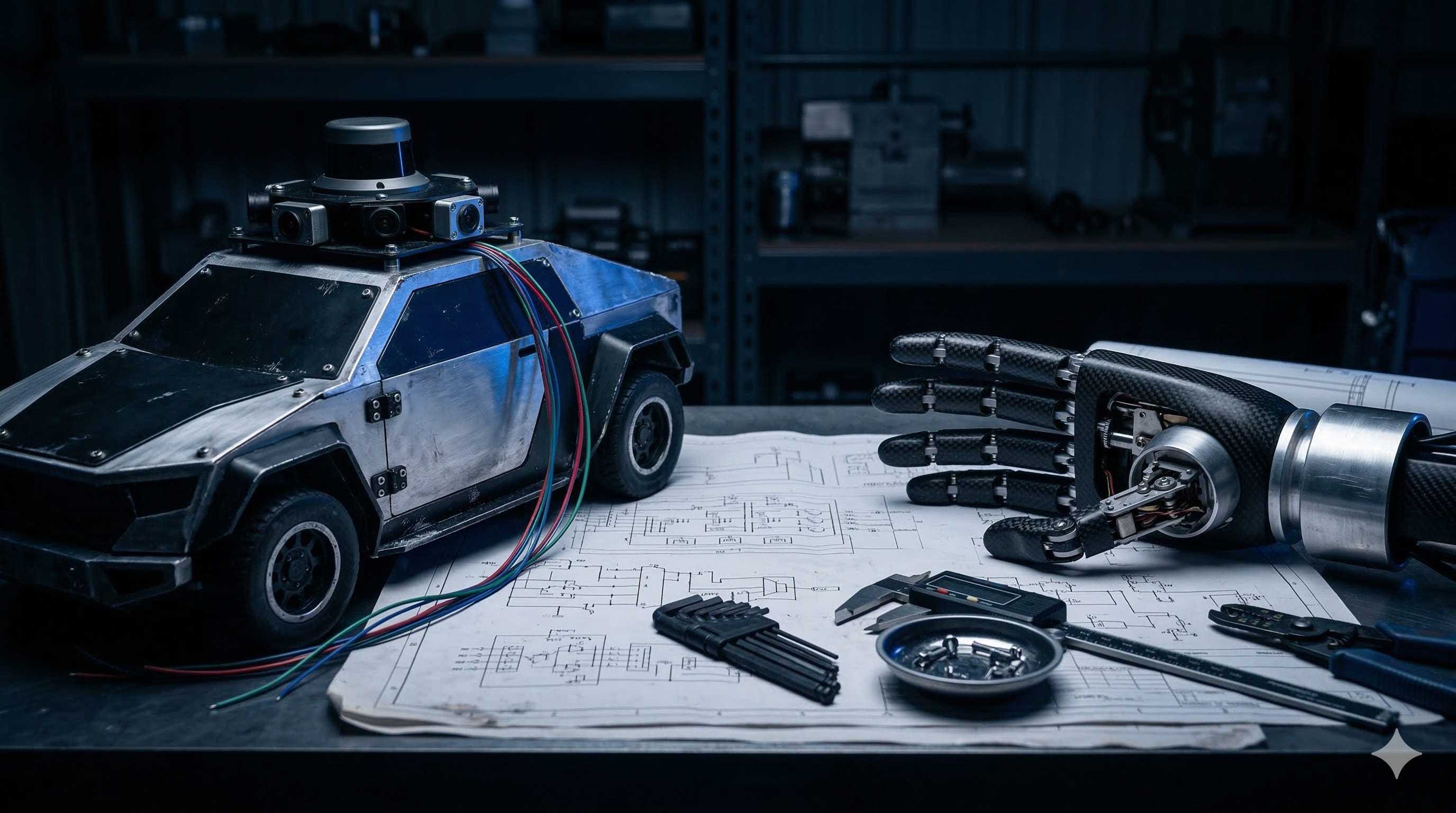
In 24 months, at least two humanoid startups currently valued above $1 billion will either pivot to restricted industrial domains or begin the quiet wind-down that Argo AI started in 2022. Give or take a funding cycle. The structural math doesn’t change with an extra round.
Not because of bad engineering. Because three structural forces:
the promise of general-purpose robotics,
the belief that foundation models close the capability gap, and
trillion-dollar investor narratives have compounded into valuations that no near-term deployment can justify.
This is the same compounding that produced $12.4 billion Argo AI, $30 billion implied Cruise, and an autonomous vehicle industry that burned through roughly $100 billion before the survivors emerged.
Who’s Writing This
I spent a decade building perception systems at Apple and Rivian. Safety-critical systems where the gap between demo and deployment isn’t abstract. It’s the difference between a working product and a recall.
I built and led the perception organization at Rivian from the ground up. At Apple, I shipped systems across the AI Research, and Vision Pro groups where “works in the lab” meant nothing if it didn’t work in production. For the past year, through ManifoldStack, I've been independently researching the humanoid sector, talking to companies across the space, from executive leaders pitching their vision to operator engineers describing what actually works on the floor
In almost every conversation, I heard echoes of pitches I sat through in 2016 and 2017. The same confidence in data volume. The same timelines. The same gap between the demo reel and deployment reality. The companies that shut down sounded exactly like this.
This is a structural analysis from someone who’s been on both sides of the deployment cliff.
The Numbers That Should Worry You
Humanoid robotics startups raised $6.1 billion across 139 deals in 2025, a 300%+ year-over-year surge from $1.5 billion the year before.
And 2026 is accelerating, not cooling. In Q1 alone: Skild AI raised $1.4 billion at a $14 billion valuation. Neura Robotics is reportedly raising $1.2 billion. Sunday Robotics hit unicorn status at $1.15 billion. Figure AI hit a $39 billion valuation on its Series C. Apptronik crossed $5.5 billion. 1X Technologies was targeting $10 billion+.
These numbers mirror the autonomous vehicle funding peak of 2017-2021. The AV industry burned through roughly $100 billion before the shakeout settled, and the list of companies running sustainable commercial operations today can be counted on one hand.
The AV graveyard is worth studying. Argo AI peaked at $12.4 billion, employed 2,000 people across 7 cities, and dissolved in October 2022 when Ford recorded a $2.7 billion impairment. Volkswagen wrote off another EUR 1.9 billion. Cruise cost GM over $10 billion in cumulative losses before shutting down operations in December 2024. An October 2023 incident exposed fundamental failures in how the org was wired. Their post-mortem ran 105 pages, drew on 88 interviews and 200,000+ pages of internal documents, and concluded that the culture systematically deprioritized field safety data relative to schedule pressure.
Meanwhile, Waymo, which started with a single suburb in Arizona and spent years being mocked as a “geo-fenced science project,” is now running 450,000+ paid rides per week, valued at $126 billion, and targeting one million weekly trips this year. Waymo had an advantage most startups won’t: a parent company willing to absorb years of losses. But the strategic choices it made during those years (constrained domain, deployment-first org, safety investment before regulation) are replicable without Alphabet’s balance sheet.
The difference wasn’t the algorithm or the bankroll. It was deployment discipline and the patience to build depth before breadth.
Three structural promises explain why the humanoid industry is set up to learn this lesson the expensive way. I know these forces intimately because I’ve watched this movie before.
Promise #1: The General-Purpose Form
The core promise is real: a general-purpose robot that handles delegated tasks of all kinds, making human life exponentially safer and more efficient, freeing us to use our creative energy to build stronger civilizations. I believe in that future. What I don’t believe is that the current path gets there.
The pitch across the sector sounds the same. Figure AI’s stated mission is general-purpose humanoid robotics. 1X markets their NEO robot as handling “completely novel tasks” autonomously. Musk projects “more humanoids than humans by 2040.”
Same bet the AV industry made with Level 5: full autonomy, anywhere, anytime. The industry spent a decade and tens of billions learning that the gap between “can handle most scenarios” and “can handle all scenarios” isn’t a gap. It’s a cliff.
I call this the Deployment Cliff. Getting a physical AI system from 90% reliability in controlled environments to 99.9% in unstructured ones represents 90% of the engineering effort. The last 10% of capability consumes 90% of the resources. Every AV company that pursued general autonomy hit this cliff. The survivors (Waymo, Aurora, Nuro) abandoned the general-purpose pitch and constrained their domain.
The timeline tells the story. DARPA proved autonomous driving was possible in 2004. Waymo reached scaled commercial operation twenty years later and is only now approaching positive unit economics in its most mature markets. Two decades from proof-of-concept to commercial viability. Most humanoid companies are projecting 3-5 year timelines to general-purpose deployment. That's not ambition. That's a prior the AV industry already falsified.
And humanoids have it worse. AVs at least operate in a bounded state space: roads have lanes, traffic has rules. Humanoid manipulation is unbounded: arbitrary objects, deformable materials, contact physics that no simulator models faithfully. A towel fold involves continuous deformable contact that challenges every physics engine on the market.
Look at what’s actually deployed. Every commercially shipping humanoid today is doing exactly one thing. Agility’s Digit has moved over 100,000 totes at GXO. Figure’s robots logged 1,250 hours at BMW handling parts on a controlled factory line, contributing to 30,000 BMW X3 units. That’s real traction. But the gap between “handles parts at BMW” and “general-purpose robot” is the same gap that separated “drives well in Chandler, Arizona” from “Level 5 autonomy.”
That gap isn’t a failure. It’s a signal. The companies treating it as a signal (Agility narrowing to warehouse logistics, Figure deepening its BMW deployment) are building the deployment wedge that Waymo proved works. The companies treating it as a temporary condition are standing at the edge of the cliff.
Promise #2: Foundation Models Close the Gap
The humanoid industry has absorbed one lesson from large language models: scale solves everything. More data, more compute, more parameters. This worked well for text. The assumption is it’ll work for robots, hopefully.
This is the most expensive unexamined assumption in robotics right now.
GenAI scaled on three dimensions simultaneously: internet-scale text data at near-zero marginal cost, training parallelization across GPU clusters, and architectures that rewarded scale with emergent capabilities. Physical AI operates under different constraints. You can scrape the internet for video of manipulation, and companies like Rhoda AI ($450M Series A, March 2026) and Physical Intelligence ($400M) are betting that video pretraining bootstraps physical understanding. But video is observational. It captures what a grasp looks like, not what it feels like. Robots still generate their most valuable data through physical action: slow, expensive, and bounded by real-world environments.
The ICLR 2025 scaling laws paper made this concrete. Researchers compared 100,000 trajectories from two identical lab environments versus ~1,600 trajectories across 32 varied environments. The smaller, more varied dataset won across nearly every metric. The implication: environmental diversity matters more than data volume — by roughly a 4:1 ratio based on the paper’s benchmarks.
If you’re allocating capital to humanoid robotics, this changes the math. A company collecting teleoperation data from 100 identical robots in the same lab is optimizing the wrong axis. The company running manipulation tasks across 32 different configurations (different contact physics, different object properties, different environments) with engineered diversity will ship faster on 1/100th the data.
The Waymo parallel is exact. They discovered what I call the 95/5 rule: 95% of their most valuable training data came from 5% of driving scenarios. The remaining billions of miles were confirmation. They stopped chasing miles and started chasing scenarios. That’s when their deployment advantage showed up.
I’ve lived this tradeoff twice. Building Bird’s Eye View perception for Rivian Autonomy and image synthesis pipelines for Apple Vision Pro, we learned the same lesson from both sides: more data doesn’t necessarily beat better algorithms. The promise of weak supervision and self-supervision keeps you in the 80 of the 80-20. Impressive in the lab, insufficient in production. The last 20% requires engineered diversity, not brute-force collection.
Let me give the other side its due. VLAs (Vision-Language-Action models like RT-2, pi0, and NVIDIA’s GR00T N1) do provide useful priors. They compress the perception problem. A VLA trained on internet-scale visual data understands “pick up the blue cup” without task-specific training. That’s real progress. It’s why this isn’t 2016 AV.
But here’s what they don’t solve: pre-training diversity is observational, not physical. A model that’s seen a million images of hands gripping objects doesn’t understand the contact forces of gripping a wet plastic container at 4 degrees Celsius. Rodney Brooks put it bluntly: human hands have roughly 17,000 specialized tactile receptors. Current robots have nothing equivalent. Teleoperation data captures no force feedback at the wrists, limited finger control, and 1-3cm precision. “Today’s humanoid robots won’t learn how to be dexterous despite hundreds of millions or billions being donated by VCs.”
AgiBot’s GO-1, trained on over one million trajectories across 217 tasks, achieved 78% task completion. Manufacturing needs 95%+. The curve flattens. This is diminishing returns on volume, not the sharp capability emergence that scaled LLMs.
A question worth asking any humanoid company: what percentage of your roadmap assumes scaling data will close the gap vs. building deployment infrastructure? If the answer is above 70%, the company is running on a prior the AV industry spent a decade and $100 billion falsifying.
Promise #3: The Trillion-Dollar TAM
Morgan Stanley projects a $5 trillion humanoid market by 2050. Citi puts it at $7 trillion. Even Goldman Sachs, the most grounded of the three, revised their 2035 forecast sixfold upward from $6 billion to $38 billion. These numbers assume general-purpose capability that doesn’t exist and deployment timelines the AV industry spent a decade falsifying.
The valuation math is familiar. Skild AI at $14 billion. 1X targeting $10 billion+. Apptronik at $5.5 billion. Figure AI at $39 billion. All at valuations that dwarf their current revenue, where it exists at all. Argo AI peaked at $12.4 billion with zero commercial revenue. Cruise reached $30 billion implied with single-digit millions. Both dissolved or suspended operations.
China’s NDRC has publicly warned about a bubble: 150+ companies, over half new startups or pivots, few verified commercial use cases. IEEE Spectrum’s Evan Ackerman noted in January 2026 that the actual progress in 2025 was difficult to reconcile with the scale of money and hype that had flooded the sector. Morgan Stanley’s own research note cautioned that the next industry reset would likely be driven by the realities of physical AI development, manufacturing hurdles, and a shakeout among startup players.
The talent pipeline tells the same story. Kyle Vogt, former CEO of Cruise, raised $150 million for The Bot Company to build household humanoid robots. The AV-to-humanoid migration is literal. Whether the operational lessons are migrating with the talent, or just the ambition, is the open question.
The Counterargument, and Why It’s Partially Right
The bull case is real. I’m not dismissing it.
Cost barriers are collapsing faster than anyone projected. Unitree’s R1 launched at $5,900, a price point that was supposed to be five years away. Goldman reports 40% year-over-year manufacturing cost declines versus their projected 15-20%. Unitree shipped roughly 5,500 G1 units in 2025 alone, the highest volume globally.
Foundation models are a real capability jump. GR00T N1, pi0, RT-2/RT-X represent real architectural progress. Physical Intelligence demonstrated manipulation skills transferring across eight different robot embodiments. This isn’t vaporware.
Labor economics are pulling in the right direction. Target robot operating costs of $2-10/hour versus $17-25/hour for warehouse and manufacturing labor. Demographic cliffs in developed nations are real and accelerating.
And some companies are constraining their domain wisely. Agility’s warehouse focus. Figure’s BMW deployment deepening. Amazon’s task-specific approach with over one million specialist robots. These are deployment wedges in action.
The bull case is right about the destination. It’s wrong about the timeline and the vehicle. Believing that humanoid robotics will create enormous value while questioning whether valuations have outrun deployment evidence isn’t skepticism. It’s engineering judgment applied to capital allocation.
The companies that win will have what I call the Deployment Moat: proprietary operational data at scale, production deployment maturity, and the organizational capability to close the research-to-production gap repeatedly. Most current humanoid companies have one leg of that triad. A few have zero.
Why the Industry Doesn’t Update
This is the question I keep coming back to: why does an industry with full access to the AV experiment’s results continue making the same choices?
Incentive alignment.
The venture capital model, as structured for most humanoid deals, optimizes for demo impressiveness on fixed timelines. A company pitching “95% reliable assembly in seven years under a deployment-first org” raises less than one promising “a foundation model for embodied AI with remarkable results in 18 months.” Not because individual investors lack judgment, but because fund structures, LP timelines, and competitive deal dynamics create selection pressure for capability narratives over deployment evidence.
GenAI provides plausible cover. “We’re doing foundation models, so scaling data is sufficient” works as a pitch. It happened in language. Maybe this time is different. That prior was reasonable in 2020. The update should have happened by now.
And there’s a founder selection effect. The people who internalized AV’s lessons tend to join established robotics companies or found deployment-first startups. The pure-research humanoid companies attract founders who believe architecture or scale will solve the problem, not people who’ve lived through what happens when org structure and deployment discipline are afterthoughts.
The industry has the data. The incentives make it expensive to use it.
Five Signals That Separate Shippers from Folders
If you’re investing in, hiring into, or building within this space, here’s what I’d look for:
1. Demo-to-deployment ratio. If a company’s public demonstrations outnumber its commercial deployments by more than 10:1, the org is likely optimized for marketing, not operations.
2. Revenue existence. Valuation divided by revenue should be a number, not undefined. When the multiple stretches past any defensible benchmark, it’s a bet on a narrative, not a business.
3. Data strategy honesty. Is the company optimizing for teleoperation volume or environmental diversity? If the pitch is “we’re building 500 robots to collect more data,” ask how many distinct physical configurations those robots are training across.
4. Safety architecture. Does the company have a Chief Systems Engineer? A formal hazard analysis? Deterministic safety layers separate from the learned system? ISO 25785-1, the first international safety standard for bipedal robots, published in May 2025. The companies building to that standard now will own the regulatory moat when enforcement catches up. Safety culture disputes are already surfacing across the sector, including at least one federal lawsuit alleging a safety engineer was terminated after raising concerns. These cases are worth tracking regardless of outcome.
5. Org structure. Does the org chart look more like Waymo’s (embedded cross-functional teams, deployment milestones, safety authority at the executive level) or like pre-shutdown Cruise’s (research silos, demo culture metrics, safety separate from operations)? Show me the org chart and I’ll tell you the robot’s failure mode.
What Comes Next
Over the next four articles, I’ll break down each of these signals with the structural evidence behind them:
The Deployment Wedge: why starting narrow is the only proven path to scaling wide
The Data Flywheel Illusion: why ICLR’s scaling laws research should reshape how you allocate capital
Conway’s Law for Humanoids: why your team structure is building your robot’s failure modes
The PARI Framework: a five-dimensional scoring rubric for deployment readiness, tested against well funded physical AI companies over the past six months
The trillion-dollar question isn’t whether humanoids will create value. It’s which companies will accept the constraints necessary to capture it before the capital runs out.
The autonomous vehicle industry already gave us the answer. The survivors narrowed their domain before expanding it. Revenue came from deployed systems, not demo days. Safety investment happened before regulation forced it. And they optimized for task fitness, not investor aesthetics.
The humanoid industry has 24 months, give or take a funding cycle, to learn this lesson. Or to repeat it.
Stay on the signal path. - Vinay
The four-part structural series starts next week. Part 1: The Deployment Wedge, why starting narrow is the only proven path to scaling wide. Subscribe so it hits your inbox.
All 25+ sources are hyperlinked inline. This article represents the author’s structural analysis and opinion based on publicly available information, not investment advice.